
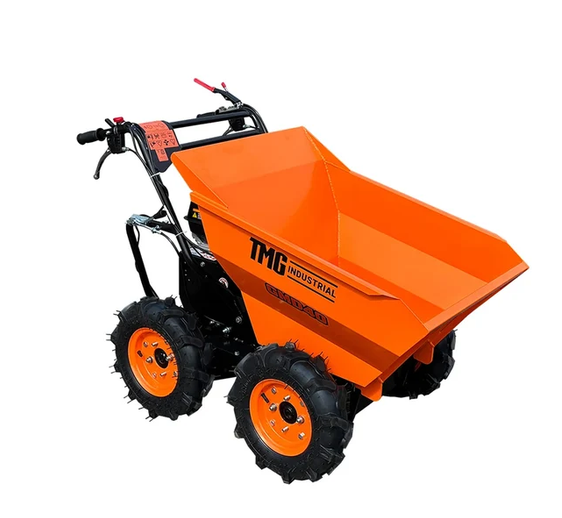
Drive configuration reads like a performance feature, and on a machine that travels at walking pace it clearly is not. What driving every wheel buys is the ability to keep moving on ground that is wet, loose or sloped, which on most sites is the difference between finishing a load and winching a machine out. An all wheel drive wheeled dumper is specified for traction rather than for anything that happens on hard standing, and it competes with a concrete buggy on exactly that ground.
One spinning wheel stops the whole load
On a two wheel drive mini dumper with an open differential, torque follows the path of least resistance. The moment one driven wheel loses grip it takes all the available torque, spins, and the machine stops regardless of how much grip the other wheels still have. That is why a loaded barrow stops on a patch of mud no larger than a dinner plate. Nothing has failed; the drive has simply found an easier place to put its effort.
What all wheel drive changes about that
Driving every wheel means a single slipping wheel has three others still contributing. The machine keeps moving while grip is restored, and in practice most soft ground is patchy enough that at least two wheels always have something to push against.
It also spreads the effort, so each tire works less hard and tears up a surface less. On a lawn or a landscaped area that is often the real benefit rather than the ability to climb anything steeper.
Gradient and what a three speed box gives you
Three forward speeds on a mini dumper are not about going faster. First gear multiplies engine torque for climbing with a full hopper, third covers the empty return trip, and second exists for the loaded run across level ground.
Using the gearbox properly matters more on a small engine than on a large one. A 196cc engine lugging in too high a gear on a slope overheats its clutch, and clutch wear is the most common failure on machines in this class.
What the ground will actually carry
Eight hundred and eighty pounds is the machine rating. The limit on a soft lawn, a new slab or a bridge deck is the ground, and a loaded mini dumper puts its weight onto four contact patches far smaller than those of a tracked machine.
Checking the surface rather than the specification is the habit worth building. A machine that sinks is a machine that has to be dug out, and the time lost there exceeds anything gained by carrying a full load.
Loading is where the balance goes wrong
A hopper loaded unevenly puts weight forward or off to one side, and on a short wheelbase machine that shifts the center of gravity much further than the same load would on a larger one, which is felt first as steering that pulls.
Three habits cover most of it:
- Load over the axle, not against the front
- Keep heavy material low in the hopper
- Reverse up ramps with a full hopper
The last one is the same reasoning that applies to any loaded machine on an incline, and it is worth making a habit rather than a judgement call. Weight stays on the uphill side of the machine, and the operator ends up behind the load rather than beneath it.
Why gasoline still wins on some sites
An electric power wheelbarrow is quieter and has no emissions, and for indoor and residential work that decides it. On a wet rural site a day’s work can exceed what a battery delivers, and there is nowhere to charge.
A 6.5 horsepower gasoline engine refuels in a minute and does not care how cold it is. That is the honest argument for petrol on a site with no power, and it is why both types continue to sell.
Tires and what they are doing
Tread pattern matters more than tire size on a machine this light. A knobbly tread finds grip in soft ground and marks a finished surface; a turf tread does the opposite. Pressure is the adjustment most owners never make. Dropping pressure spreads the contact patch and improves flotation on soft ground, and raising it again for hard surfaces reduces rolling resistance and wear.
Reading the specification against the site
On a mini dumper, payload, engine power and hopper capacity are the listed figures. Drive layout, gear count, overall width and tire type describe whether the machine gets where the load has to go. TMG Industrial builds this one with all wheel drive, a 196cc engine and three speeds. Deciding what the ground is like on the worst day of the job, rather than on the day of the demonstration, is what makes the drive configuration worth paying for.