
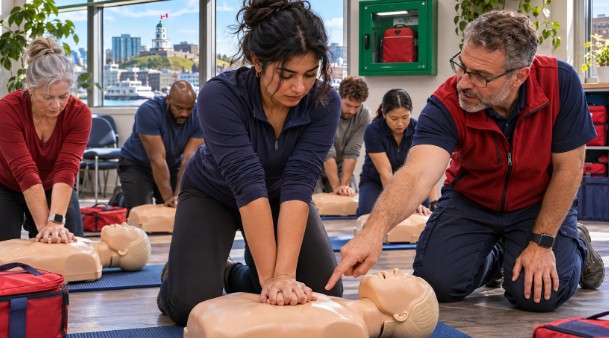
CPR and AED training teaches ordinary people to keep a failing heart going until help arrives. A course takes about a day, needs no medical background, and can double or even triple a person’s chance of survival. Here is what you’ll learn, who needs it, and how to start.
Most of us read about remarkable lives. Few of us picture the quiet moment that could write us into someone else’s story. A CPR C and AED course in Halifax prepares you for exactly that moment, whether it happens at work, at the rink, or at the dinner table.
What Happens When a Heart Suddenly Stops?
Cardiac arrest is an electrical problem. The heart stops pumping, and the person collapses. No pulse. No normal breathing. No response.
It’s not the same as a heart attack, even though people mix them up. A heart attack is a blocked artery. The person is usually awake and in pain. Cardiac arrest is faster and far more final.
Heart & Stroke estimates that roughly 60,000 Canadians have a cardiac arrest each year, and fewer than one in ten survive. That number sounds heavy. But it has a hopeful side, and we’ll get to it next.
Why Does Bystander CPR Matter So Much?
Because the first few minutes belong to whoever is standing closest. Paramedics are fast, but they’re rarely instant.
Every minute without blood flow lowers the odds. Chest compressions keep blood moving to the brain and heart. Heart & Stroke says CPR from a bystander can double or even triple the chance of survival.
Think about that. You don’t need a degree or a uniform. You need to know what to do and be willing to start.
Here’s the catch: most people freeze. They wait for someone braver, or someone trained. A course trains the freeze out of you.
What Will You Learn in a CPR and AED Course?
A good course is practical. You spend more time on your knees beside a manikin than sitting in a chair. Expect to cover:
- How to check if someone is responsive and breathing
- When and how to call for emergency help
- Chest compressions at the right depth and speed
- Rescue breaths for adults, children, and infants
- How to use an AED, step by step
What Is an AED, and Is It Hard to Use?
An AED, or automated external defibrillator, is the wall-mounted box you’ve probably walked past in a mall, gym, or office lobby. It looks serious. It isn’t scary.
Open it and it talks. It tells you where to place the pads, listens to the heart’s rhythm, and decides whether a shock is needed. It won’t shock someone who doesn’t need it. You really can’t get it wrong.
Practising once with a trainer unit turns “I hope I never have to touch that” into “I know exactly what to do.”
Does Age Change How You Do CPR?
Yes, a little. Adults, children, and infants all need compressions, but the hand position, depth, and breath timing differ. A fuller course covers all three, which matters if you’re a parent, grandparent, teacher, or coach. Babies and toddlers don’t get a vote on where their emergencies happen.
Do You Need a Medical Background?
No. Not even close.
Courses are built for complete beginners. The instructor starts from zero, uses plain language, and lets you practise until the steps feel natural. If you can follow a recipe, you can learn this.
Many providers now offer blended learning. You finish the theory online at your own pace, then attend a shorter hands-on session. It fits around a busy week, which removes the most common excuse for putting it off.
Who Should Take One?
Short answer: nearly everyone. Longer answer, with a few examples:
- Parents and caregivers. Kids choke, fall, and swallow things. Training gives you a plan instead of panic.
- Workplace teams. Offices, shops, and job sites all have emergencies. One trained colleague changes the outcome.
- Coaches and fitness staff. Hard exercise and cardiac events can overlap. Be ready.
- Students heading into healthcare or childcare. Many placements ask for a current certificate.
- Anyone with older relatives. Most CPR is performed on someone the rescuer knows and loves.
That last point is the real argument. You probably won’t use CPR on a stranger. You’re far more likely to use it on someone whose story you already know.
What Makes the Skills Stick?
Practice, and a refresher. Skills fade when you don’t use them, and that’s normal. Most certifications are valid for a limited time, so check yours and book a renewal before it lapses.
Two small habits help. Know where the nearest AED is at your workplace and at the places you visit often. And rehearse the steps in your head once in a while: check, call, compress, shock. Thirty seconds on a bus ride is enough.
How Do You Get Started in Halifax?
Pick a course that matches your needs, whether that’s workplace, family, or a certificate for school. Then book a date, show up, and get your hands on the equipment. The whole thing takes less time than a long weekend errand, and the payoff lasts years. If you want support from a team that teaches this every day, you can also book with Coast2Coast First Aid and choose a session that suits your schedule.
Every life story has turning points. Some are planned. The best ones, sometimes, are the ones where you knew what to do.
If you are looking for first aid and CPR training in Halifax or the wider Halifax Regional Municipality, then you may reach out to Coast2Coast First Aid & Aquatics in that area.