
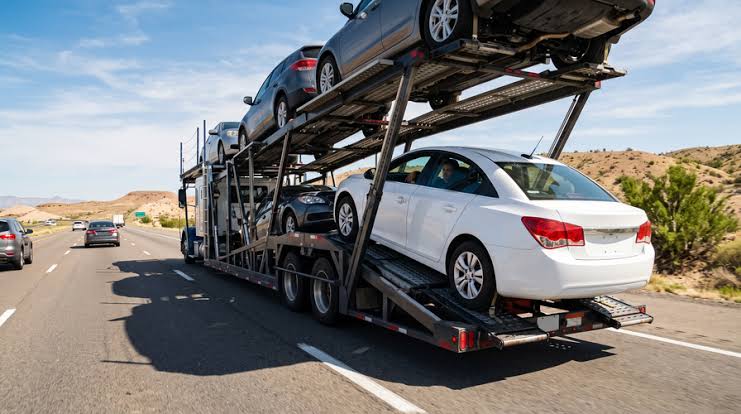
Most cross-country car shipments land between $1,000 and $1,800 on an open trailer. Rates work out around $0.64 to $0.88 a mile on long routes, so Los Angeles to New York runs near $1,800, Chicago to Miami near $1,100 and New York to Chicago near $700. Enclosed transport costs 30 to 50 percent more. Expect 10 to 15 days on the road for a coast-to-coast trip, and book one to two weeks before you want the car collected.
What you are actually paying for
The number on a quote is not a flat rate for a service. It is the share of a truck’s operating costs that your car represents for the length of the trip.
A loaded car hauler carries up to ten vehicles. The driver has fuel, insurance, truck payments, hours-of-service limits and a route planned around which cars come off where. Your quote is roughly one tenth of running that truck for however many miles, adjusted for how hard your particular car is to pick up and drop off.
That is why the per-mile figure falls as distance rises. A 400-mile trip costs more per mile than a 2,800-mile one, because the paperwork, the loading, the unloading and the phone calls take the same effort either way.
Real route prices
Published averages give a usable starting point.
| Route | Average, open trailer |
| Los Angeles to New York | about $1,800 |
| Chicago to Miami | about $1,100 |
| New York to Chicago | about $700 |
Those are open-trailer prices for a standard sedan. Work backwards and the rate sits between $0.64 and $0.88 a mile on long-haul routes, which is the band most quotes fall into.
Anything far outside that band is worth a question. A quote at half the average usually means the load is priced under what a driver will accept, and the car sits in the driveway until the price comes up.
The six things that move the number
What it costs to transport a car to another state comes down to distance first, then six other factors.
Route density. Trucks run some corridors constantly. Interstate 95 down the East Coast, Interstate 10 across the south, Interstate 80 across the middle. A pickup or delivery near one of those is cheap. A farm road in eastern Montana is not, because somebody has to drive out there and back for one car.
Vehicle size and weight. A sedan takes one slot. A Suburban or a dually pickup takes more deck space and more weight allowance, and the quote reflects it. Expect $100 to $300 more for a large SUV or truck on a long route.
Open or enclosed. Open trailers move the large majority of cars in the country, including most new cars delivered to dealerships. Enclosed trailers cost 30 to 50 percent more and carry fewer vehicles. They make sense for classic cars, original paint, low ground clearance or anything you could not easily have repainted.
Whether the car runs. A vehicle that will not start or steer has to be winched aboard, which needs specific equipment. Say so when you book. Discovering it at pickup means a wasted trip and a rebooking.
Season. Summer is busy everywhere. Autumn loads up southbound routes as seasonal residents head to Florida, Arizona and Texas, and spring reverses it. Shipping against the main direction of travel is the simplest way to pay less.
How flexible your dates are. A pickup window of several days lets a dispatcher slot your car onto a truck already heading your way. Demanding a specific day means building a route around you, and that costs money.
What about the cheap quote
Every first-time shipper gets one quote noticeably below the others and wonders whether they found a deal.
Usually not. In this business the price has to be high enough that a driver agrees to take the load. Dispatch boards show available cars and what each pays; drivers pick the ones that work. A car priced below the going rate for its lane just sits there.
The customer experiences that as a delay. Nobody explains that it was a pricing decision made at booking.
Published averages are the defense here. If four quotes cluster around $1,100 and one says $740, the outlier is the one that needs explaining.
How long it takes
Transit time depends on distance, once the car is actually loaded.
| Distance | Time |
| Under 800 miles | 1-4 days |
| 800-1,499 miles | 4-7 days |
| 1,500-2,399 miles | 6-10 days |
| 2,400 miles and up | 10-15 days |
Pickup is separate. Most companies assign a driver within one to three days of your requested date, sooner on busy corridors and slower for remote addresses.
Two things stretch those numbers. Winter weather across the Rockies and the northern plains, and the simple fact that your car is one of ten stops on a route.
Door to door, and what a door means
Door-to-door is the standard service and the phrase is slightly misleading.
A loaded hauler runs around 80 feet long. It cannot turn into a cul-de-sac, pass under low branches or stop on a narrow residential street in a dense city without blocking it. Door-to-door means the driver gets as close as the law and physics allow, then calls to arrange somewhere nearby. In practice that is often a supermarket car park.
Terminal-to-terminal is the alternative. You drop the car at a yard and the recipient collects it from another one. It saves roughly $50 to $150 but costs time, and storage fees start if nobody collects promptly.
Who you are hiring
Most vehicle transport in the country is arranged by brokers. A broker finds a hauler already running your lane, agrees a rate and handles the paperwork, without owning any trucks. Companies like Monarch Transport Group work this way, through a network of vetted carriers.
Nothing wrong with the model, but it changes two things. First, the company you booked with is not the company that will be holding your keys. Second, a damage claim goes to the hauler, through its cargo insurance, which typically covers around $100,000 per vehicle on open trailers and more on enclosed.
Before you book, check the company’s MC number in the FMCSA SAFER database. It is free, public and takes a minute. Operating authority should read active.
Keeping the cost down
Four things actually work.
Give a pickup window of three to five days instead of one date.
Book one to two weeks ahead. Earlier rarely helps, because drivers are dispatched close to the date. Later narrows your options.
Meet the truck somewhere accessible if your street is tight. A ten-minute drive to a wide lot can shave the awkward-access premium.
Ship outside the peak direction when you can. A move to Florida costs less in January than in November, if your dates allow it.
One thing that does not work: packing the car full of belongings to save on the moving truck. Personal items are generally not covered by cargo insurance, add weight, and many haulers refuse loaded vehicles outright.
Before the truck arrives
- Wash the car and photograph every panel, the roof and the odometer, with dates on the images.
- Leave about a quarter tank of fuel.
- Remove toll transponders, parking passes and anything loose.
- Fold the mirrors in and switch off the alarm.
- Note every existing scratch on the Bill of Lading at pickup, and check the car against that same form in daylight before signing at delivery.
Do not skip that last one. Anything you leave off the delivery copy before you sign is very hard to argue afterwards.
FAQ
How much does it cost to ship a car 2,000 miles?
Between roughly $1,280 and $1,760 on an open trailer, using the $0.64 to $0.88 per mile range. Enclosed transport adds 30 to 50 percent.
Is it cheaper to drive the car myself?
On a long move the totals are closer than people expect once fuel, hotels, meals and wear are counted. Driving also adds a couple of thousand miles to the car and several days to your schedule.
How far ahead should I book?
One to two weeks for most routes. Add a few days in peak season.
When do I pay?
Many companies take nothing upfront and collect the balance on delivery. Ask about deposits and cancellation terms before you book.