
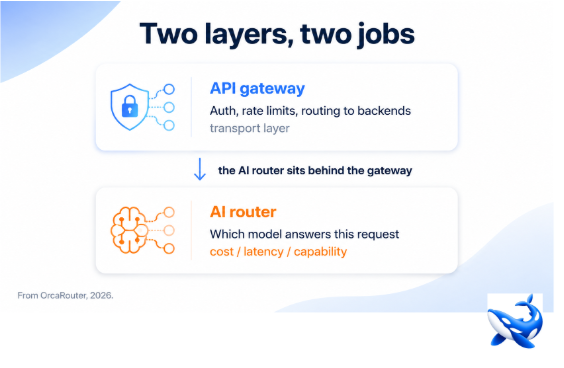
The terms “API gateway” and “AI router” get used almost interchangeably, and the confusion is expensive, because they solve different problems at different layers. An AI router decides *which model answers a request*; an API gateway decides *which service a request reaches*. OrcaRouter is an AI router — and understanding the difference is the difference between building the right infrastructure and building two copies of the same thing.
The API gateway’s job
An API gateway sits in front of your services. It handles the transport concerns: authentication, rate limiting, request routing to specific backends, response transformation, logging, and often billing. If you have a web app and a payments service and a search service, the gateway is the front door that sends each request to the right door behind it.
For LLM APIs specifically, a gateway might wrap the OpenAI or Anthropic APIs, manage keys, track usage, and apply rate limits. That is genuinely useful. But it is routing to *vendors*, not routing *between* them intelligently.
The AI router’s job
An AI router sits behind the gateway and makes a different decision: given this prompt, which model should answer it — from a pool of models across vendors?
That decision is not “which URL do I hit” but “which model is the right one for this request”. It considers:
- Cost — is this a task where a cheap model is good enough?
- Latency — which model returns fastest for this workload right now?
- Capability — does this request need the frontier model or will a smaller one do?
- Availability — is the preferred provider up, or should this fail over?
The output of that decision is then sent to the appropriate provider — the gateway’s concern — but the *choice itself* is the router’s. The router is where the intelligence about models lives; the gateway is where the plumbing lives.
Where they overlap and where they diverge
| Concern | API gateway | AI router |
| Auth, keys, rate limits | ✓ | — |
| Routing to backend services | ✓ | — |
| Choosing between LLM providers | limited | ✓ |
| Per-request model selection (cost/latency/capability) | — | ✓ |
| Failover between providers | manual | automatic |
| Unified token/cost tracking across vendors | partial | ✓ |
The overlap is the trap. Both can call multiple LLM providers. But a gateway that can call both OpenAI and Anthropic is not an AI router — it’s a gateway with two backends. The router’s differentiator is the *decision rule*: cheapest-first, task-aware routing, automatic failover, cost-per-request accounting. That is a layer of intelligence the gateway doesn’t have.
The practical consequence
Teams that conflate the two end up in one of two situations:
Gateway-only: They can reach multiple vendors but must decide themselves which to call, per request, in code. The switching logic lives in the application, gets re-implemented per team, and never accounts for current provider health or real cost. This is where “we use five models” quietly means “we hand-pick every call.”
Router-plus-gateway (correct): The gateway handles the transport front door; the AI router handles model selection behind it. One API key, one compatible endpoint, a configurable pool of models, automatic failover, and per-call cost accounting. Your application asks “give me the best answer within my budget” and the router does the deciding.
The second arrangement is also what makes the model landscape tolerable. When a model’s price rises or a better one ships, the change is a router configuration — not a gateway reconfiguration, and certainly not a rewrite of your application’s calling code.
A rule of thumb
If your concern is “which of my microservices handles this request”, that’s a gateway problem. If your concern is “which model answers this prompt, and did we pick the economical one”, that’s an AI router problem. Most production LLM setups need both — but they need them as separate layers, not as one confused middlebox.
A concrete example
Suppose your product summarises documents for customers. Without a router, you picked one model and one provider, paid its price, and lived with its availability. With a router, the pool has the summarising work on a cheap fast model, the harder analysis on a stronger one, and a fallback provider if the primary is down. The request still lands at your API gateway — auth, rate limits, your own front door — but the decision about which model does the summarising happens behind it, automatically. That is the two-layer design in action: the gateway you already have stays, and the router slots in behind it to make the model decision you used to make by hand, one request at a time, against live cost, latency and health data.
Why the distinction is worth money
The distinction is not academic, because it determines what you buy and what you build. A team that buys a gateway believing it is a router gets reach to multiple vendors and still makes every model decision in code — the exact thing that is expensive to change later. A team that understands the router as a decision layer gets the model choice automated and reconfigurable. The difference is whether “switch to a cheaper model” is an afternoon configuration change or a multi-week integration project. That is what the gateway-versus-router distinction is worth, and it is why the two belong as separate layers rather than as one confused middlebox.
The takeaway
An API gateway routes requests to services; an AI router chooses which model answers a request, by cost, latency, capability and availability. They’re not the same thing, and conflating them produces a gateway that can reach two vendors but leaves the actual model decision to your application code. The correct architecture is both layers: the gateway at the front door, the AI router behind it making the per-request model decision. That’s what separates “we have access to many models” from “we automatically use the right one.”
Sourcing note: this article contrasts the API-gateway category with the AI-router category and describes OrcaRouter’s implementation. OrcaRouter’s claims — per-request model selection, automatic failover, unified token/cost tracking, one compatible endpoint — are its own published descriptions, checked August 2026.