

Starting IVF can, quite frankly, be a jarring experience. Most couples walk into it thinking that this treatment will have a clear path forward and a clear end goal, only to quickly realise that IVF is not a single treatment but a series of steps that unfold over several weeks. When that happens, it is easy to ask yourself, “How long is this actually going to take?”
Truthfully, the answer varies from person to person, depending on many factors, including personal circumstances, the clinic’s approach, and how your body responds to treatment. That being said, there is still a somewhat predictable timeline most couples can expect with IVF. Keeping that in mind, let’s break down what happens during each stage of this treatment and how much time we should realistically expect to spend on this journey.
How long does the consultation and fertility testing stage take in an IVF?
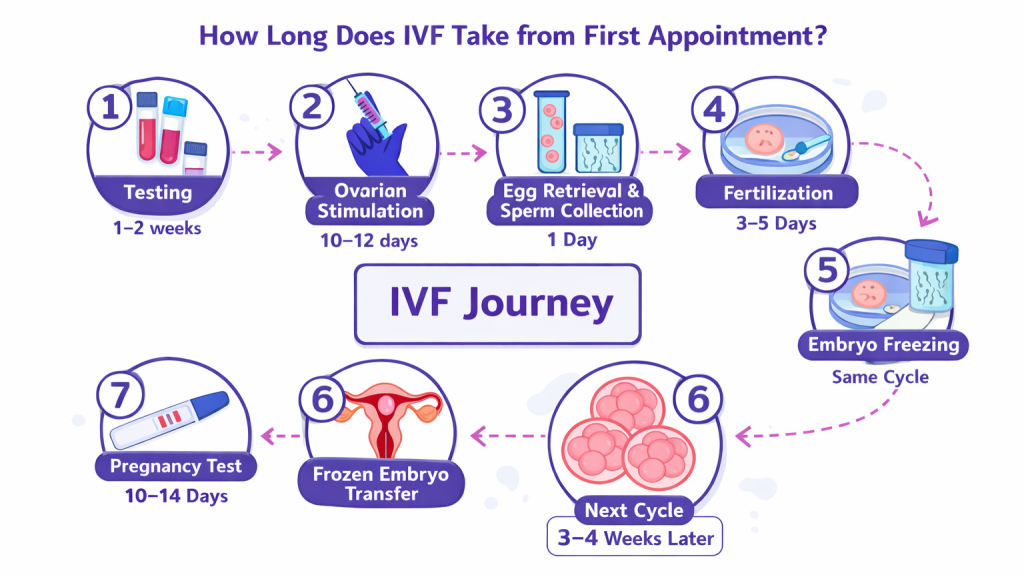
Before you actually undergo the procedure itself, your doctor and the fertility team will need to build your case. To this end, the first stage you’ll go through will involve a slew of consultations, medical history reviews, fertility assessments, and diagnostic testing.
For women, this also includes hormone blood tests, ovarian reserve testing, and ultrasound scans. For men, it typically includes a semen analysis to assess sperm health and quality. Now, depending on how quickly your appointments can be arranged and whether your case requires any additional investigation, this part of the process can take anywhere from 1 to 3 weeks. Some people tend to move through it very quickly, while others may need further testing before a treatment plan is created. Rest assured, whatever pace you and your clinic are going at, it is only for your safety and to improve your chances of success.
What is the timeline for the ovarian stimulation stage of IVF?
During the ovarian stimulation stage, the doctors will use certain fertility medications to encourage your ovaries to produce multiple eggs at once, rather than the single egg that they normally release during a menstrual cycle. For most women, this part of the process can last 10 to 14 days, and throughout it, you will need to attend monitoring appointments. These will allow your doctors to conduct blood tests and ultrasound scans to track follicle development.
The duration of the stage tends to vary from person to person, as some women respond very quickly to stimulation medication, while others require a slightly longer protocol to achieve the same result. While some studies have linked the duration of stimulation to IVF outcomes, most doctors consider neither to be clearly better than the other. During this stage, expect more frequent appointments, sometimes at different times, as timing plays a key role in this stage. Another thing to expect is some symptoms that may accompany the medication, such as temporary bloating, fatigue, or mood changes as your hormone levels rise. That being said, reputable places such as The Fertility & Gynaecology Academy, an IVF clinic in London, will explain all of these things well in advance, so you can adjust your everyday life as needed and avoid any unexpected obstacles during the process.
How long does embryo transfer take in an IVF?
In a fresh IVF cycle, this step usually occurs between 2 and 5 days after your eggs are collected. The egg collection process itself is also a very small procedure that does not even require anaesthesia. However, do note that it is not necessary to proceed directly to the transfer. In some situations, the clinic or your doctor may ask you to freeze your embryos and schedule a frozen embryo transfer later. They generally suggest this for one of two reasons: either your hormone levels are unusually high, or there are concerns about your uterine environment at the moment. If these situations apply to you, your treatment may get extended by several weeks or even months. But what’s arguably more difficult is the part that comes next: the waiting period that follows an embryo transfer. This is a particularly arduous period of 10 to 14 days during which you practically do nothing and just wait for the time that you can take a pregnancy test. Not only that, but this period can feel even more troubling, partly because the symptoms themselves are somewhat unreliable indicators of success or failure. If implantation is unsuccessful during this period, the cycle will have to be repeated.
What factors can make your IVF journey longer?
From everything discussed above, it should be clear that a standard IVF cycle typically lasts between 4 and 8 weeks for most couples. At the same time, this is not a textbook timeline, and many factors can significantly extend this process. For instance, some patients may need additional fertility investigations before treatment begins. Others may require adjustments to their medications if their ovaries are not responding as expected. Previously, as mentioned, if the doctors recommend freezing the embryos, then the transfer may be further delayed to improve your chances of success. Age, fertility diagnosis, previous treatment history, and individual medical circumstances will all weigh heavily in determining how quickly your treatment progresses as well. Let’s also not forget that if you are accessing IVF through NHS-funded pathways, waiting times before treatment will add several months to the overall journey, depending on availability.
Walk into an IVF with optimism and confidence
Upon reading some of that, it is natural that some of you may feel disheartened by the very notion of IVF, along with its timeline. If you’re about to start this treatment, the best thing you can do for yourself is to maintain the attitude of informed optimism. While everything about the IVF may sound like a long process, each of these stages exists for a reason, and your fertility doctors are doing everything they possibly can to give you the best possible chance of success. Yes, waiting can be difficult, arduous, and even torturous, but now that you are informed of the timeline in advance, try to be a little more patient with this process. If nothing else, it will allow you to focus less on the uncertainty surrounding this process and more on each step of the journey as it arrives. If you can do that, everything else will be just fine.