

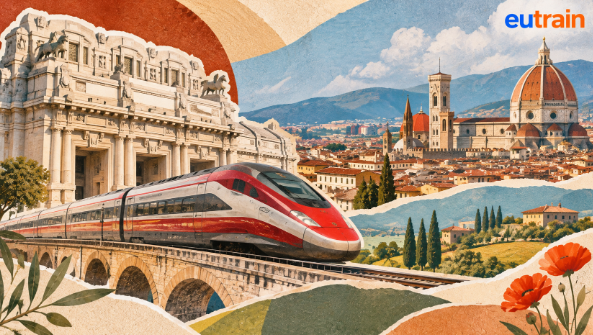
Italy has a way of making even the journey between cities feel like part of the holiday. You might spend the morning wandering through Milan’s fashionable streets, have lunch near the railway station, and find yourself walking through Florence’s Renaissance-era buildings before the afternoon is over. With high-speed trains connecting the two cities in around two hours, combining Milan and Florence in a single itinerary is surprisingly straightforward.
Still, a smooth train journey involves a little more than choosing a departure time. Italy’s major railway stations can be busy, particularly for visitors unfamiliar with the language or the local transport system. Knowing which station to use, when to arrive, and what to expect at the other end can make the experience considerably easier.
For anyone beginning their journey in Milan, checking a Milano Centrale station guide before departure is a sensible first step. The station is one of Italy’s major railway hubs, serving high-speed, regional, and international trains, and understanding its layout can save a lot of unnecessary searching on the day of travel.
Leaving Milan Without the Last-Minute Rush
Milano Centrale is impressive the first time you see it. Its monumental architecture and enormous concourse feel closer to a historic landmark than an ordinary transport terminal. But beyond the architecture, it is a working station handling a constant flow of passengers heading to destinations throughout Italy and beyond.
The first thing to remember is that you should follow the train number and departure information rather than relying only on the city name. Italian departure boards often display the train’s final destination, which may be farther along the route than your own stop. If your train is continuing beyond Florence, the destination shown on the board might be somewhere else entirely. Checking the train number alongside the departure time is a much safer approach.
For a high-speed journey, arriving around 20–30 minutes before departure is generally a comfortable choice, especially when carrying luggage. Unlike airports, railway stations do not usually require passengers to arrive hours in advance, but allowing time to check the platform and pass through any access controls makes the start of the trip less stressful.
You will also want to consider where you are staying in Milan. Although Milano Centrale is well connected to the city’s metro network, it may not be within walking distance of your hotel. If you are coming from Malpensa Airport, remember that the airport is outside the city and reaching Centrale requires a separate transfer. When a flight and long-distance train are booked independently, leaving a generous connection window is especially important.
Once aboard, the journey itself is refreshingly simple. High-speed services operated by Trenitalia and Italo connect Milan and Florence, with many journeys taking roughly two hours. Depending on the service, you may pass through areas around Reggio Emilia and Bologna before continuing into Tuscany. It is a comfortable opportunity to relax, read, or enjoy the changing scenery without the usual complications of airport travel.
Arriving in Florence: A Different Kind of Station Experience
Florence offers a noticeably different arrival experience from Milan. Where Milano Centrale feels grand and monumental, Firenze Santa Maria Novella is more closely integrated into the historic city. Its location is particularly convenient for visitors staying near the centre, and many of Florence’s best-known attractions are accessible on foot.
That convenience is one of the reasons travelling to Florence by train works so well. After leaving the station, you can walk toward the Basilica of Santa Maria Novella, continue through the historic streets, and eventually reach the Duomo without needing a complicated transfer across the city.
However, Florence does have multiple railway stations, and not every train stops at the one most convenient for tourists. Firenze Santa Maria Novella, commonly abbreviated as Firenze S. M. Novella or Firenze SMN, is the principal central station for many high-speed services. Firenze Campo di Marte and other stations serve different routes and travel needs, so checking the full station name before booking is essential.
If Florence is your first stop in Tuscany, a Florence train station guide can help you understand the station’s location, nearby transport connections, and what to expect when you arrive. This becomes particularly useful if you have luggage, need to reach accommodation outside the historic centre, or plan to continue toward smaller Tuscan towns.
Making the Most of a Milan–Florence Itinerary
Although the rail journey is short enough to make a day trip possible, spending at least one night in Florence allows visitors to experience the city at a more comfortable pace. Florence’s appeal lies partly in its atmosphere: the narrow streets, small cafés, historic piazzas, and evenings when the busiest tourist areas gradually become quieter.
A reasonable itinerary might begin with two or three days in Milan, followed by a morning train to Florence. Arriving around lunchtime leaves plenty of time to check into your accommodation and explore the historic centre without rushing. The following day can be reserved for major sights such as the Uffizi Gallery, the Accademia, or the surrounding neighbourhoods.
When booking the journey, it is worth looking beyond the cheapest advertised fare. Departure time, ticket flexibility, the exact arrival station, and whether the service is direct can all affect how convenient the journey feels. Advance tickets may offer attractive prices, but the conditions for changing or cancelling them can vary considerably between fare types.
Travellers should also remember that train schedules, platform assignments, and ticket conditions can change. Check the latest departure information with the operator before travelling, and keep your ticket accessible on your phone or in printed form if preferred.
There is something particularly enjoyable about travelling between two cities that feel so different. Milan is energetic, modern, and internationally connected, while Florence offers a more intimate introduction to Italy’s artistic and architectural heritage. The train makes it possible to experience both without losing much of the holiday to transportation.
With a little preparation at each station, the journey becomes more than simply getting from one destination to another. It becomes an easy, enjoyable part of discovering Italy.