
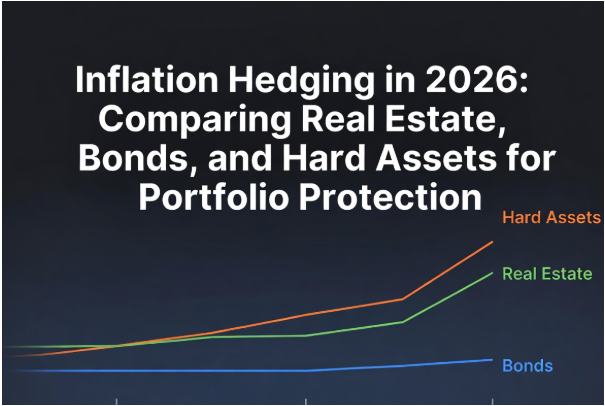
Inflation does not announce itself politely. It compounds quietly until one day a portfolio that looked adequate no longer covers what it was supposed to. The question of how to protect against it is not new, but the answer has changed. Bonds, the traditional hedge, spent three years delivering the worst real returns in modern history. Real estate held up better but is not the simple inflation pass-through most investors assume. Hard assets — gold, silver, commodities — behaved in ways that surprised both bulls and bears.
Understanding which instruments actually protect against inflation, and under what conditions, matters more now than it did a decade ago when central banks could rely on rate cuts to smooth any disruption. For investors who want direct exposure to precious metals as part of that strategy, the guide to investing in precious metals covers the full range of instruments available.
Why Most Traditional Hedges Failed the Last Inflation Cycle
The conventional inflation-protection playbook going into 2022 was: hold TIPS, add real estate, keep some gold. Two of those three underperformed badly. TIPS, Treasury Inflation-Protected Securities, are designed to adjust with CPI. What they cannot absorb is the simultaneous rise in real yields that occurs when the Fed tightens aggressively. From January 2022 to October 2022, the iShares TIPS Bond ETF fell approximately 15% in nominal terms even as CPI ran above 8%. The inflation adjustment was real; the duration loss was larger.
Real estate was more complicated. Physical property held value in nominal terms through 2022 and into 2023, because rents were rising with inflation and supply remained constrained. REITs told a different story: publicly traded real estate investment trusts fell sharply as rising rates compressed cap rate valuations. The same asset performed completely differently depending on whether you held it directly or through a listed vehicle. That distinction matters for any inflation strategy.
Gold rose modestly in 2022 but dramatically underperformed its own historical role as an inflation hedge through most of that year. The explanation is real yields: gold pays no income, so when real yields rise sharply, the opportunity cost of holding gold increases and prices fall. Gold’s protection kicks in when inflation persists and real yields remain low or negative, not when central banks are hiking rates fast enough to push real rates positive.
What Each Asset Class Actually Offers
Each inflation hedge works through a different mechanism, and matching the mechanism to the inflation scenario matters more than picking the “best” hedge in the abstract.
Real estate generates income that can be repriced with inflation. Long-term leases with fixed rents do not protect in the short term. Short-duration leases, residential rental properties, and industrial warehouses with frequent rent resets do. The inflation protection is real but comes with illiquidity, leverage risk, and geographic concentration that most portfolio models underweight.
| Asset Class | Inflation Mechanism | Works Best When | Fails When |
| Physical real estate | Rent repricing, asset scarcity | Supply constrained, rents rising | Rates rise fast, cap rates compress |
| REITs | Same as physical, but liquid | Stable rate environment | Real yields rise sharply |
| TIPS | CPI adjustment on principal | Inflation mild, real yields low | Fed hikes fast, real yields spike |
| Gold | Safe-haven, currency debasement | Real yields negative or falling | Real yields rising rapidly |
| Silver | Industrial demand plus monetary | Economic expansion with inflation | Industrial slowdown, strong dollar |
| Commodities broad | Direct price exposure | Supply shocks, demand surge | Demand destruction, dollar strength |
| Short-duration bonds | Rapid reinvestment at higher rates | Rate hikes are rapid and sustained | Rates fall quickly |
Gold is not an inflation hedge in the narrow sense. It is a currency debasement hedge and a hedge against loss of confidence in monetary institutions. The two overlap with inflation but are not identical. The periods where gold performs best are those where real yields are negative — where inflation is running faster than interest rates — not simply any period of rising prices.
Commodities in aggregate are the most direct inflation expression available. When energy prices rise, CPI follows. Agricultural prices feed through to food inflation. Industrial metals move with production costs across the economy. Holding a broad commodity index gives the most mechanical relationship to headline inflation, but it also introduces volatility that few investors can tolerate through a full cycle.
Building a Portfolio That Survives Different Inflation Scenarios
The error most investors made going into the 2022 hiking cycle was holding a single inflation hedge and assuming it would work in any environment. Scenario-specific positioning is more resilient.
For mild, persistent inflation with negative real yields — the 2020-2021 environment — gold and REITs work well. For sharp inflation driven by supply shocks — 2022 — direct commodity exposure and physical real estate outperform. For a stagflationary environment with high inflation and weak growth, gold tends to hold up while cyclical commodities and real estate both suffer. For a disinflation scenario where inflation falls faster than rates, short-duration bonds and cash equivalents preserve more purchasing power than any real asset.
The World Gold Council has consistently recommended allocating 5-15% of an investment portfolio to gold as a baseline diversification position. Silver’s dual role as a monetary and industrial metal makes it more volatile but potentially higher-returning in expansion periods where industrial demand amplifies the monetary bid. Platinum and palladium introduce sector-specific exposure that is harder to read as a macro inflation hedge.
Physical precious metals held directly eliminate counterparty risk. ETFs backed by physical metal, like the SPDR Gold Shares or iShares Silver Trust, give the same economic exposure with higher liquidity and no storage costs, though they reintroduce the institutional layer that physical holders are trying to remove. Mining stocks offer operational leverage to metal prices but add company-specific execution risk and correlation to broader equity markets that reduces their value as a pure inflation hedge.
The Practical Construction of an Inflation-Resistant Allocation
No single instrument covers every inflation scenario. A practical inflation-resistant allocation combines assets that work through different mechanisms and perform across different interest rate environments.
A starting point is a 10-15% allocation to hard assets divided between gold ETFs or physical gold and a broad commodity index. Add 10-20% to real estate through direct property or short-lease REITs, avoiding long-duration fixed rent structures. Keep bond duration short — short-term Treasuries or floating rate instruments — to reduce the rate sensitivity that crushed long-duration fixed income in 2022. Maintain enough cash or cash equivalents to reinvest opportunistically when assets reprice.
The key discipline is rebalancing. Inflation hedges tend to spike during the specific shocks they are designed for and then give back gains as conditions normalize. An investor who held commodities through 2021-2022 and rebalanced into bonds and equities as commodity prices peaked captured the inflation protection and then reinvested at more attractive valuations.
Conclusion
Inflation hedging is not a single trade. It is a portfolio construction problem with multiple moving parts and scenario-dependent answers. Real estate hedges through rent repricing but fails when rates rise fast enough to compress valuations. Bonds protect only when duration is short or when real yields are high enough to compensate for the inflation drag. Gold and silver protect against currency debasement and real yield compression but not against aggressive central bank tightening. Commodities are the most direct inflation expression but introduce volatility that requires conviction and active management.
The investors who navigated the 2022 cycle best were not those who had picked the right single hedge. They were those who held a diversified basket of real assets, kept bond duration short, and rebalanced as individual positions ran. That process does not require predicting inflation. It requires building a portfolio that does not depend on getting the forecast exactly right.