
“How long does it last?” sounds like a straightforward question. For a rechargeable pod device, however, it can refer to three different things: the time between charges, the lifespan of the supplied e-liquid, or the working life of the device itself.
The IVG PRO 10000 brings these questions together because its name includes a puff-count claim while the hardware is designed for repeated charging and pod replacement. Understanding its lifespan starts with separating those measurements.
There is no single number of days that reliably answers all three questions. The specifications explain what the device contains, but individual usage determines how quickly its available power and liquid are consumed.
Three Different Meanings of “Lasts”
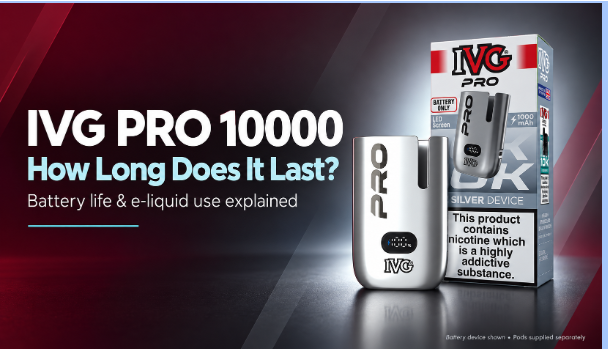
The original IVG PRO uses a rechargeable 1000mAh battery. Its 10K refill format combines a 2ml prefilled pod with a 10ml refill container, providing 12ml of liquid across the connected components. IVG advertises up to 10,000 puffs from that refill arrangement and states that puff counts are approximate.
These details describe separate resources:
| Measurement | What It Describes | What It Does Not Establish |
| Battery runtime | Use available between charges | How long the liquid will last |
| Refill lifespan | Time before the supplied liquid is depleted | The working life of the device |
| Hardware lifespan | How long the reusable device remains functional | A guaranteed number of refill packs |
Keeping these categories separate prevents a common misunderstanding: the advertised puff total is not a promise that the device will deliver 10,000 puffs on one charge.
What the Battery Specification Tells You
The 1000mAh rating describes battery capacity. The original PRO also has a battery indicator and charges through a USB-C connection. Its battery is built into the housing.
Capacity alone cannot establish an exact operating time. That calculation would also require information about electrical demand and how long the device is activated.
Consider two hypothetical users. One takes occasional short draws, while the other uses the device more frequently. Even with identical hardware, their time between charges would not necessarily match.
This is why a statement such as “lasts all day” needs context. It may describe a manufacturer’s expectation under certain usage conditions, but it is not a universal measurement. The battery indicator provides information about charge status; it should not be interpreted as an e-liquid gauge.
Why the Liquid Supply Follows a Different Timeline
The pod and refill container supply liquid independently of the battery’s charging cycle. IVG’s instructions describe connecting the 2ml pod and 10ml container before inserting the assembly into the device.
That arrangement provides a finite quantity of liquid. Charging restores electrical energy, but it does not replenish what has already been consumed.
Consequently, needing to recharge does not automatically mean the refill is finished. Equally, a full battery does not establish that sufficient liquid remains.
The auto-fill description concerns how liquid moves within the supplied system. It should not be confused with unlimited refilling or the addition of bottled liquid. Once the supplied contents are exhausted, IVG describes replacing the refill assembly while retaining the functioning device.
Why Dividing 10,000 by Daily Puffs Can Mislead
A tempting calculation is to divide the advertised puff figure by an estimated number of daily draws. The arithmetic is simple, but the result can appear more reliable than the assumptions behind it.
For example, dividing 10,000 by 500 produces 20 days. That is a mathematical illustration, not a verified lifespan for this product.
The calculation assumes that every draw corresponds to the conditions behind the advertised figure and that the individual actually receives the full claimed total. Without a matching test method and measured personal use, neither assumption is established.
A “puff” is also not a standard calendar unit. Counting draws without considering their duration gives only a partial picture of consumption. The advertised maximum therefore cannot support a guaranteed replacement schedule.
What Changing Performance Can—and Cannot—Tell You
A device producing less aerosol does not, by itself, identify the cause. Low charge, depleted liquid, connection problems, or a fault can require different responses.
That makes observation more useful than immediately assuming that the whole device has reached the end of its life. Charge information, the condition of the refill, and the manufacturer’s troubleshooting instructions should be considered separately.
IVG’s setup guidance specifically directs users to check battery percentage and identifies the correct connection between the pod and refill container. These are distinct checks within the system.
If performance remains abnormal, the appropriate next step is manufacturer support rather than forcing components, opening the battery housing, or treating an advertised puff count as a target that must be reached.
How Long Should the Reusable Device Remain Functional?
The device’s working life extends beyond a single refill, but the manufacturer information reviewed does not provide a guaranteed lifespan in months or charging cycles. It describes the hardware as reusable while acknowledging that replacement may eventually be needed.
That is an important limit. “Rechargeable” explains a function; it does not mean that battery performance remains unchanged indefinitely.
IVG’s care guidance advises keeping the device away from excessive heat and direct sunlight and avoiding extended storage with the battery fully depleted. These are care instructions, not a guarantee of a particular service life.
For an existing adult user, the most meaningful answer comes from distinguishing the observed charging interval, refill replacement interval, and condition of the hardware. Those three observations describe actual experience far more clearly than treating “10000” as a fixed duration.