

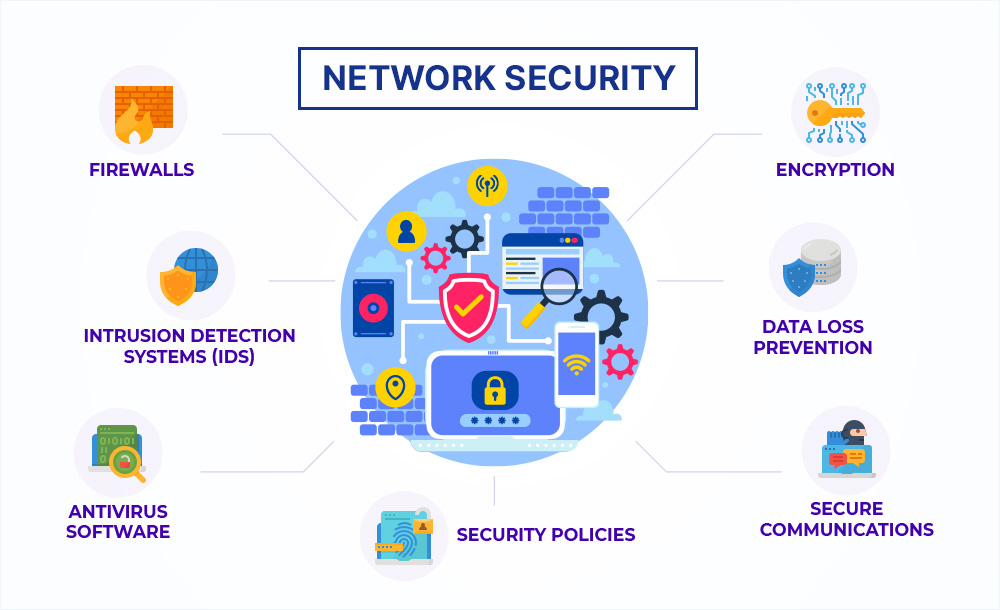
Network security is rarely based on a single tool or technology. Instead, it consists of distinct controls designed to address different types of risk and work together to protect an organization’s data, systems, and users as information moves across the network. Understanding what each control is designed to accomplish, where it fits within the broader security architecture, and why no single measure is sufficient on its own is an important capability for anyone responsible for protecting enterprise infrastructure.
At first glance, the variety of network security technologies can be confusing. Rather than viewing any one control as a complete solution, organizations need to understand how these layers work together. A firewall or intrusion detection and prevention system alone is insufficient. Access control, encryption, and segmentation each address different risks. VPNs are important for remote access security but do not constitute a complete network defense strategy. Email and web security can stop many threats from entering the environment, but their effectiveness also depends on broader security policies and user awareness. This article describes several major categories of network security controls, explains their roles, and shows how they contribute to a defense-in-depth strategy.
Readers looking for a broader foundational overview of network security concepts will find a useful starting point in the resource on types of network security controls explained, which covers the core principles behind protecting network infrastructure from unauthorized access and disruption.
Firewalls: The Perimeter Foundation
Firewalls remain among the most established and important network security controls, acting as a gatekeeper between trusted internal networks and untrusted external environments such as the public internet. A firewall evaluates traffic against defined rules and allows or denies connections according to factors such as source and destination addresses, ports, protocols, and connection state.
More advanced next-generation firewalls extend inspection beyond basic network information to the application layer. They can identify individual applications regardless of the ports being used and may integrate capabilities such as intrusion prevention, application control, and deeper traffic inspection into the same policy framework.
Firewalls remain essential, but they are no longer viewed as a complete security solution on their own. Modern environments have become more distributed as organizations adopt cloud services, support remote work, and allow branch locations and users to connect directly to internet-based applications. These changes have weakened the traditional distinction between the trusted inside of the network and the untrusted outside.
As a result, firewalls are most effective when treated as one layer within a larger defense-in-depth architecture rather than as the sole technology responsible for protecting the organization.
Intrusion Detection and Prevention Systems
While firewalls decide which traffic is permitted to enter or leave a network, intrusion detection and prevention systems focus on identifying suspicious or malicious activity within permitted traffic.
Intrusion detection systems analyze network activity, compare it with known attack patterns or behavioral baselines, and alert security teams when potentially malicious activity is detected. Intrusion prevention systems go a step further by operating inline with network traffic and blocking identified threats in real time rather than simply notifying administrators after detection.
These systems address risks that a traditional firewall may not detect. A firewall might allow traffic through a permitted port because the connection itself satisfies policy requirements, but that decision does not necessarily reveal whether the content carried within the connection contains an exploit or another form of malicious activity.
Intrusion detection and prevention technologies help close this gap by examining traffic patterns and, where appropriate, payload content for signs of compromise. They provide a dedicated layer intended to identify and potentially stop attacks that have already passed basic connectivity controls.
Network Segmentation: Reduce Blast Radius
Network segmentation divides a larger network into smaller, controlled zones so that organizations can apply more specific access policies and security controls. The underlying idea is straightforward: if an attacker compromises one area of the network, segmentation can limit the ability to move freely into other areas.
Federal guidance on this approach, detailed through network segmentation security guidance published by the Cybersecurity and Infrastructure Security Agency, describes segmentation as a physical or virtual architectural approach that divides networks into multiple subnetworks, each providing additional control compared with a flat environment.
In practice, segmentation can be implemented through technologies such as firewalls, virtual local area networks, and access control policies that allow communication between segments only when business requirements justify it.
This becomes especially important when organizations need to separate sensitive environments, including financial systems, operational technology, or administrative infrastructure, from general-purpose user networks. If one endpoint or network zone is compromised, effective segmentation can reduce the attacker’s ability to reach more sensitive systems.
Segmentation also provides security teams with additional time and visibility during an incident. Containing suspicious activity within a limited part of the environment can make detection, investigation, and remediation more manageable than responding to an attacker moving freely across a flat network.
Access control: Defining Who Has Access to What
Access control determines which users, devices, applications, and systems are permitted to interact with network resources and what actions they can perform after access has been granted. It includes several related functions, particularly identification, authentication, and authorization.
Identification establishes who or what is requesting access. Authentication verifies that claim, while authorization determines which resources and actions the verified identity is allowed to use.
A breakdown of these components, drawing on government guidance around identity and access management, identifies the access control system elements that contribute to effective access governance. These include mechanisms that control connectivity, authentication and authorization processes such as multifactor authentication, cryptographic protections for credentials and sensitive information, and auditing capabilities that establish accountability for activity performed on systems.
Effective access control is closely tied to the principle of least privilege. Users and systems should receive only the permissions required to perform their legitimate tasks rather than broad access by default.
This approach reduces the potential impact of compromised credentials. If an attacker gains control of an account with narrowly scoped permissions, the resources available through that account are more limited than they would be in an environment where broad privileges are routinely assigned.
Encryption: Encrypting Data in Transition and Rest
Encryption protects confidentiality by transforming information into a form that cannot be read without the appropriate decryption key. It can protect data while it is traveling across a network and while it is stored.
For data in transit, protocols such as Transport Layer Security create encrypted communication channels between systems. If network traffic is intercepted while being transmitted, encryption helps prevent an unauthorized party from reading the contents.
Encryption at rest protects information stored on devices, servers, databases, or other media. If storage is stolen, improperly accessed, or otherwise compromised, correctly implemented encryption can prevent the underlying information from being immediately readable.
Encryption operates differently from several other network security controls because it does not necessarily determine who can connect to a network or resource. Instead, it protects the data itself.
This makes encryption an important additional defense when other controls fail. Access control, segmentation, and firewalls may reduce the likelihood of unauthorized access, but if an attacker still reaches a storage system or intercepts communications, properly encrypted data can remain protected.
VPNs and Secure Remote Access
Virtual private networks establish encrypted tunnels between remote devices and private networks, allowing users to reach internal resources through public or otherwise untrusted networks such as the internet.
Historically, VPNs have been a common method for secure remote access. They combine user authentication with encrypted communication between the remote endpoint and the organization’s network, helping protect data from interception while users work outside the traditional office environment.
Organizations are increasingly supplementing or changing traditional VPN approaches with architectures such as zero trust network access, which evaluates and authorizes individual access requests instead of automatically providing broad network connectivity after a tunnel has been established.
Regardless of the specific technology, the core goal remains similar: remote connections should be authenticated, encrypted, and limited according to what each user actually needs to access.
Remote access security also depends on endpoint condition, identity controls, and ongoing monitoring. Encrypting a remote connection does not compensate for a compromised endpoint or an account with excessive permissions, which is why secure remote access must operate alongside other network and identity controls.
Email and Web Security
Email and web traffic remain two of the most common channels attackers use to gain an initial foothold in enterprise environments. Email and web security therefore represent distinct but important categories of network protection.
Email security technologies inspect inbound messages for phishing attempts, malicious attachments, suspicious links, and other indicators of threats. They may also monitor outbound communications to help prevent sensitive information from leaving the organization improperly.
Web security controls govern access to websites and browser-based applications. They can block known malicious destinations, filter content that violates organizational policies, and inspect web traffic for threats delivered through browsers or internet-facing services.
These controls address risks created when users interact with external content, an area that basic network-level filtering alone may not fully address. Attackers frequently target users because convincing someone to open a malicious attachment or visit a fraudulent site can be easier than directly exploiting perimeter infrastructure.
Why These Controls Work in Tandem, Not in Silos
No single category of network security control can address every risk facing an organization. A firewall without intrusion detection may permit malicious activity hidden inside otherwise allowed traffic. Strong access controls without encryption may still leave information exposed if communications or storage systems are compromised. Segmentation can limit lateral movement, but its effectiveness is reduced if users within each segment have unnecessarily broad privileges.
This is the fundamental principle behind defense in depth: organizations combine different layers of protection so that the failure of one control does not automatically result in a complete security failure.
Effective network security therefore depends on understanding how individual controls complement one another. Firewalls regulate traffic boundaries, intrusion detection and prevention systems identify malicious activity, segmentation contains compromise, access controls restrict permissions, encryption protects data, remote access technologies secure external connections, and email and web security address common user-facing threat channels.
Organizations reviewing their network security posture should evaluate coverage across each of these areas rather than relying on any single technology, regardless of how capable that technology may be.
Frequently Asked Questions
Why is it eating Intrusion Detection vs Intrusion Prevention System?
Intrusion detection systems monitor network traffic and alert security teams when suspicious activity is identified, but they do not normally block that activity automatically. Intrusion prevention systems operate inline with traffic and can block identified threats in real time. Organizations may use both approaches according to their visibility and prevention requirements.
So if firewalls control access to our networks, why is network segmentation considered a best practice?
Firewalls often control traffic entering or leaving major network boundaries, while segmentation limits movement between internal zones. If an attacker compromises one area, segmentation can prevent unrestricted lateral movement into other systems, reducing the potential blast radius of the incident.
How can encryption complete access control, not replace it?
Access control determines who can reach a system or dataset, while encryption protects the information itself. If unauthorized access occurs or data is intercepted, encryption can still prevent the contents from being readable without the appropriate key.