

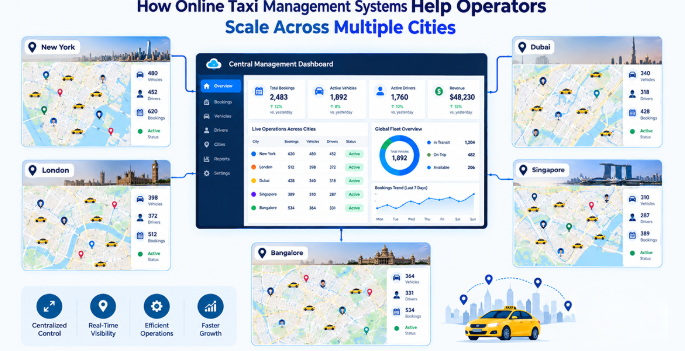
Adding a new city to a taxi operation sounds simple on paper. Open a market, recruit some drivers, and switch on the app. In practice, almost nothing about running a fleet stays the same. Not once a second city enters the picture.
Traffic patterns change from one neighborhood to the next, more so in bigger cities. Local regulations also rarely line up with each other. Riders in one market lean toward cash. Riders elsewhere expect digital wallets as the default option. Drivers carry different pay expectations too. Local market norms decide what they’ve come to expect. An online taxi management system built for one city tends to strain badly. That strain shows up the moment a second city gets added.
This piece looks at what genuinely changes with new cities. It also looks at what a taxi dispatch system needs to get right. That way, growth doesn’t slowly turn into chaos behind the scenes.
Why New Cities Rarely Match
It’s tempting to treat a new city as a copy-paste job. Same app, same pricing, same onboarding flow, just new coordinates. That approach breaks down faster than most operators expect.
A city’s traffic patterns decide how routing logic needs to behave. Dense city cores and sprawling suburbs demand very different assumptions. Local competition also influences the pricing that gets riders to book rather than switch to a competing service. Regulatory requirements decide what paperwork drivers need before they can start. Those requirements can vary wildly between neighboring jurisdictions.
None of these differences tend to show up during a demo. Demos, after all, get built around ideal conditions. A weak taxi dispatch solution rarely gets stress-tested this way. They show up three or four weeks after launch instead. Support tickets start piling up, and nobody can quite explain why.
What Actually Changes City to City
A handful of variables change the moment a fleet enters a new market. Often these only become obvious after launch.
- Traffic density and average trip speed, both of which change how ETAs get calculated.
- Local licensing rules, since some cities require permits a neighboring city never asks for.
- Payment habits, since cash still dominates certain markets while cards dominate others nearby.
- Language preferences, since a single-language app can lose riders without anyone spotting it.
- Peak hours, which change with local work culture and how reliable transit happens to be.
A capable online taxi management system treats each of these seriously. None of it works well as an afterthought.
Centralized Control, Local Execution
The real challenge in multi-city operations comes down to balance. Too much central control can prevent local teams from responding quickly to conditions that only they can see on the ground. Not to conditions that only they can actually see. Too little control, and every city slowly turns into its own disconnected silo. Dispatch management software can help maintain centralized visibility while giving teams the tools to coordinate drivers, assignments, and operations across locations.
The best taxi dispatch system setups solve this with a layered structure. That beats picking one extreme or the other. Corporate teams set overall strategy, standards, and the platform’s non-negotiables. City teams then handle whatever only makes sense locally.
One Dashboard, Every City
Operators managing five different cities shouldn’t need five separate logins. Not just to check on how the business is doing. A single dashboard that rolls every city into one view helps enormously. It solves a real, everyday headache for regional teams. That’s especially true for teams running taxi booking and dispatch software across several markets.
From that dashboard, a regional manager compares cities side by side. Trip volume, driver earnings, cancellation rates, and revenue sit together in one place. Spotting a struggling city turns into a five-minute check. That beats a week spent chasing spreadsheets from local teams.
Where Local Teams Decide
Central visibility doesn’t have to mean central micromanagement of every small choice. Some decisions genuinely belong at the city level. That’s closest to the people who live with the outcome.
- Setting local fare adjustments within a corporate-approved range.
- Approving drivers who meet regional licensing requirements specific to that city.
- Running city-specific promotions timed around local events or holidays.
- Adjusting service hours based on demand patterns and curfews unique to the area.
A well-run online taxi booking software setup still needs clear boundaries here. The right taxi dispatch solution draws this line clearly from the start. Local teams get real room to act. They don’t have to wait on headquarters for every small decision.
Setting Prices and Following Local Rules
Pricing is rarely one-size-fits-all across a genuinely multi-city operation. Fuel costs differ from region to region, and so does local competition. Rider price sensitivity changes just as much from one market to the next.
A flexible taxi dispatch software setup lets operators configure pricing city by city. The core platform underneath never needs to be touched. Base fares, per-kilometer rates, surge caps, and service fees can all vary by location. The underlying booking and matching logic stays the same everywhere.
Rules That Catch Operators
Regulations rarely announce themselves clearly. They trip up operators who expand too fast without doing the homework first.
- Driver background check standards, which can differ significantly between neighboring cities.
- Vehicle age and inspection rules, often carrying separate limits from one city to the next.
- Surge pricing caps, which some cities enforce strictly while others leave fully unregulated.
- Tax structures and invoicing requirements, rarely consistent even across nearby state lines.
- Insurance minimums for commercial rides, which vary more than most operators expect going in.
Missing even one of these during a launch carries real, tangible risk. Fines, delays, or even a shutdown order can follow quickly. All of it can happen before the first ride even starts.
How Launch Speed Changes at Scale
The first city an operator launches usually takes the longest of all. Every piece of taxi dispatch software gets built from scratch. Then it gets tested under real pressure.
City two should move faster, at least in theory. Whether it actually does depends on how the first build went. Platforms built with hardcoded pricing and local rules cause problems. A real taxi dispatch system avoids most of it. Every new city ends up feeling like starting over from zero.
A properly configured taxi dispatch software platform flips this pattern around entirely. Each new city becomes a matter of entering local parameters. Nobody has to write fresh code from scratch again. Launch timelines shrink from months down to weeks. Sometimes they shrink to just days for operators staying within a familiar region.
That speed compounds meaningfully over time. An operator who can launch a city in two weeks moves fast. A slower competitor might still be stuck on their first market.
Managing Drivers Across Regions
Driver management gets genuinely harder once a fleet spans several cities. Onboarding, verification, and payout structures all need to work consistently. Local requirements keep changing underneath all of it.
A well-built taxi cab dispatch software platform standardizes onboarding across cities. It still leaves room for city-specific document requirements underneath. A driver in one city might need a commercial permit. A driver elsewhere might need something else entirely.
When Drivers Relocate
Some drivers relocate permanently between cities. Others just want extra earning opportunities during a city’s peak season.
- Driver profiles that transfer cleanly between cities, without needing full re-verification.
- Earnings history that carries over, supporting loyalty programs and tenure-based bonuses.
- Rating history that follows the driver, rather than resetting back down to zero.
Rebuilding a driver’s profile completely from nothing wastes real time for everyone involved. That waste repeats every time a driver moves between cities. Across a large fleet, it adds up fast.
Comparing Performance Across Cities
Numbers mean very little without something to compare them against. A single city’s revenue figure tells an operator almost nothing alone. That same figure, compared against four or five other cities, tells more. It starts telling a genuinely useful story.
A mature online taxi booking software platform standardizes reporting across every market. That’s what makes comparisons actually mean something real. Trip volume in one city sits right next to another’s. Both get measured the exact same way. No local team has to invent its own spreadsheet.
Metrics Worth Tracking
A few metrics genuinely deserve consistent tracking, regardless of city size.
- Revenue per active driver, since raw citywide revenue alone tends to hide real efficiency differences.
- Average pickup time, since cities with weaker routing infrastructure need slightly different benchmarks.
- Driver retention over each driver’s first ninety days on the platform.
- Cancellation rate broken down by cause, rather than one single aggregate number.
- Customer complaint volume, normalized against total trips completed that same month.
Comparing these numbers across cities reveals which markets are genuinely healthy underneath the surface. Some markets simply look fine because nobody has taken the time to check closely.
Choosing a System Built to Scale
Not every platform built for a single city can genuinely support several at once. A polished vendor demo built around one perfect market rarely reveals this weakness upfront. This applies just as much to taxi cab dispatch software as anything else. Before committing to anything, push well past the sales pitch. Ask pointed, specific questions instead.
- Can pricing rules be configured for each city without needing custom development work?
- Does the platform support multiple languages and currencies as a native feature?
- How quickly can a genuinely new city actually launch, in days or in months?
- Is reporting standardized across cities, or does every city need its own custom setup?
- Can driver profiles move between cities without starting completely from zero?
A taxi dispatch system that answers all five has usually faced real demands. It wasn’t just built once for a single flagship market and left untested elsewhere. A provider who answers with specifics, not vague reassurance, is usually genuine. That’s the hallmark of genuine taxi booking and dispatch software, built for growth. The providers who hesitate were often built for one market only. Later, they got stretched thin to look bigger than they are.
Building for the Next City
Multi-city growth exposes weaknesses that a single-city operation never has reason to reveal. Pricing that felt flexible enough on day one suddenly stops feeling flexible at all. Reporting that felt thorough for one market suddenly hides more than it reveals. Driver management that felt smooth for one city creates friction at every new launch.
An online taxi management system built with growth in mind avoids most of this. It solves these problems well before they start. It treats every new city as a configuration exercise. Not as a full rebuild from the ground up. Local flexibility stays intact throughout the process. Corporate visibility stays complete across the entire network.
Operators planning genuine expansion should think past city number one. Build, or buy, with the fifth city already in mind. Not just the first one on the list. Planning this way can help operators reduce operational friction as they expand into additional cities. They skip the growing pains that everyone else seems to treat as simply inevitable.