

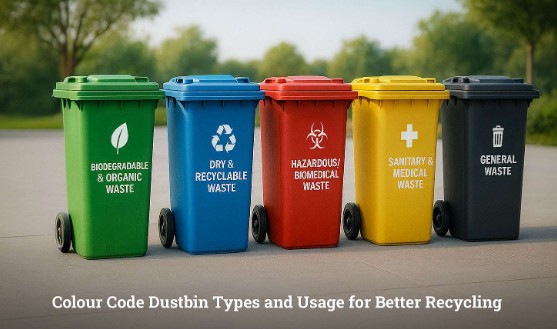
A plastic bottle dropped into the right bin looks like a small act of environmental responsibility. But what happens after the lid closes matters far more than the colour outside.
The bottle may be collected, sorted and processed into recycled material. Or it may meet food waste, enter a mixed collection stream and lose much of its value before reaching a recycling facility.
That gap between sorting waste correctly and actually recovering value from it is where India’s zero-waste ambitions become complicated.
The dustbin colour code can make segregation easier. But it only matters when segregation connects to a functioning recovery system.
Key Highlights
- Colour-coded bins encourage source segregation, but colour alone does not create recycling.
- Clean, separate recyclable material is more likely to remain recoverable.
- India’s informal collection and aggregation networks remain important to material recovery.
- Recycled plastic must compete on quality, consistency, safety, availability and cost.
- A household’s waste footprint depends on the entire recovery chain.
The Dustbin Is Only the Starting Point
India’s Solid Waste Management Rules, 2026, continue to emphasise segregation, collection and processing.
This is why the dustbin colour code matters. The colour is a behavioural signal, telling households that different materials have different destinations. But a correctly sorted bin only has value if the system preserves that separation.
Why Clean Recycling Matters
Consider two households disposing of the same plastic bottle. One puts a clean bottle into the dry-waste stream. The other places it alongside food scraps and wet paper.
But the material reaching the recycling system may have very different value.
Contamination creates additional sorting and processing requirements. Different polymers, colours, formats and contamination levels have different processing needs. A clean, predictable stream is easier to process and more likely to return to manufacturing. Segregation creates an opportunity for lower-impact resource use. It does not guarantee it.
India’s Recycling System Does Not Begin at the Municipal Truck
India’s waste sector cannot be neatly divided into “informal” and “formal” systems.
Waste pickers, small aggregators and traders have long played an important role in recovering materials with economic value. Their networks reach households and neighbourhoods in ways that formal systems do not always replicate.
Plastic can lose value at several stages. It may be poorly sorted, contaminated during collection, processed at high cost or recycled without a dependable buyer.
Circularity depends on these links.
When Recycled Plastic Has to Compete With Virgin Material
Environmental preference alone does not create a viable recycled-material market.
A packaging manufacturer needs recycled polymer to perform consistently. Depending on the application, buyers may care about colour, odour, contamination, melt behaviour, mechanical properties and batch-to-batch consistency. They need dependable supply.
This makes sustainable plastic recycling an industrial issue, not simply a waste-management issue. A recycled polymer that is inconsistent, unavailable or significantly more expensive than virgin material may struggle to become a permanent manufacturing input.
Banyan Nation is one example of this direction, combining formal recycling infrastructure with networks of informal collectors and aggregators and focusing on technology and traceability in recycled polyethylene production.
The wider lesson is that recovered plastic has to become a dependable material, not merely a waste-management outcome.
Technology Can Make the Chain More Visible
Technology can improve sorting, contamination control, process monitoring, testing and traceability. Trust is central to recycled-material markets.
A manufacturer needs confidence that recycled polymer will behave as expected. A brand making sustainability claims needs evidence behind them. A recycler needs enough control over its feedstock to produce consistent output.
Recycling is therefore about creating material reliable enough to return to manufacturing.
The Colour Code Has Limits
Bin colours are easy to understand, but they can also create false confidence.
A household may carefully separate waste and still find that everything is later collected together. Another may use the correct bin but put food-stained packaging into the dry stream. Batteries and e-waste also require separate handling.
Households need clear instructions. Collection systems need to preserve separation. Local authorities need processing infrastructure. Recyclers need viable feedstock. Manufacturers need demand for recycled material.
A Lower Carbon Footprint Depends on the Whole Chain
If a household separates a plastic bottle correctly, it has not necessarily reduced emissions by a measurable amount yet.
If the bottle is collected efficiently, sorted, processed into recycled polymer and used instead of some virgin material, there may be an environmental advantage. But every stage consumes energy and resources.
This is why the claim that recycling always reduces carbon emissions is too simplistic.
The better question is whether a material can be recovered efficiently and whether the resulting recycled material meaningfully displaces virgin resource use.
From Waste Sorting to Circular Supply Chains
A genuinely circular plastics system connects consumers, collection, aggregation, sorting, recycling, recycled resin production and manufacturing, with materials ultimately returning to consumers.
A weakness at any point can undermine the economics.
Poor collection limits feedstock. Poor sorting increases contamination. Insufficient recycling capacity leaves recovered material without a destination. Inconsistent recycled resin makes manufacturers cautious. Weak demand reduces investment incentives.
Circularity requires coordination between municipalities, waste workers, aggregators, recyclers, packaging manufacturers, brands and policymakers.
The Commercial Case for Circularity
India’s plastic recycling industry faces a practical question: can recovered material compete as an industrial resource?
Businesses using recycled polymer still have production schedules, quality requirements and cost constraints. Packaging must perform and supply must be reliable. When environmental goals meet India’s manufacturing scale, circular plastics only work if ecological objectives and commercial realities reinforce each other.
India’s Extended Producer Responsibility framework has strengthened the connection between packaging placed on the market and its recovery. But regulation alone cannot create a circular market.
The stronger signal comes when procurement decisions, product design, collection systems and recycling capacity move in the same direction.
What a More Circular Household Could Look Like
The idea of a zero-waste household can suggest that consumers are expected to solve a structural problem through better habits.
Households can reduce unnecessary consumption, reuse where practical, segregate waste correctly and keep recyclable material clean. But they cannot control collection systems or whether manufacturers purchase recycled polymer.
What they can do is make material entering the system more recoverable.
The dustbin colour code deserves attention, but not too much credit. The real achievement is keeping material identifiable, recoverable and economically useful after it leaves the home.
Conclusion
A colour-coded dustbin will not, by itself, shrink a household’s carbon footprint. But it can influence what happens next.
Accurate segregation can reduce contamination. Effective collection can preserve material quality. Better recycling can turn recovered plastic into reliable polymer. Sustained manufacturing demand can then bring that material back into the production cycle. That is the real meaning of circularity.
It is not simply about putting the right waste in the right bin. It is about making sure the right material continues to have value after the bin.
The colour of the dustbin may start the conversation. The strength of the value chain determines whether it leads anywhere.
Frequently Asked Questions
What is the purpose of a dustbin colour code?
It helps households distinguish between waste streams at the point of disposal. Its usefulness depends on whether collection and processing systems maintain that segregation.
Why is source segregation important for plastic recycling in India?
Segregation can reduce contamination and make recyclable materials easier to sort and process.
What makes recycled plastic suitable for manufacturing?
It needs to meet the manufacturer’s technical requirements. Polymer type, contamination, consistency, colour, odour, performance and traceability can all matter.
What role does the informal sector play in India’s recycling ecosystem?
Informal workers and aggregators are an important part of India’s material-recovery network. Stronger systems can integrate these networks with organised collection, processing and recycling infrastructure rather than treating them simply as a system to be replaced.