

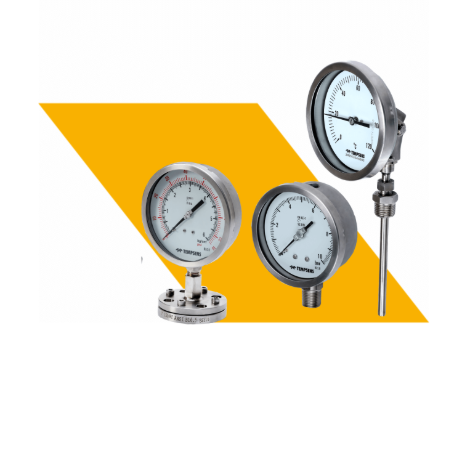
Temperature is one of the measurements that operators can’t afford to treat casually. A few degrees can affect product quality, energy consumption, equipment life, or even process safety. So wherever temperature needs watching, you need an instrument that gives a reading you can actually trust.
A temperature gauge handles this at the local level. Instead of forcing an operator to walk back to a control room and pull up a screen, it shows the process temperature right at the point where it’s being measured. Depending on what you’re monitoring, gauges come with bimetallic, liquid-filled, or gas-filled sensing elements, and they can be built for different ranges, stem lengths, connections, and mounting styles.
Temperature accuracy and traceability matter a lot in industrial settings, especially anywhere that measurement feeds into productivity or safety decisions.
Understanding Temperature Gauge
A temperature gauge is a mechanical instrument. Its job is to show the temperature of a process, a fluid, a vessel, a pipe, or an equipment surface, on a dial you can read at a glance.
Here’s how it works, generally. The sensing element reacts to temperature changes and turns that reaction into mechanical movement. That movement drives a pointer across the dial. Simple in concept, but the execution differs by design:
Bimetallic gauges. Two metals with different expansion rates bonded together. No power needed, which is part of why plants like them.
Liquid-filled gauges. These use the expansion of a liquid inside the system. They tend to hold up better where there’s vibration.
Gas-filled gauges. These rely on how gas pressure shifts with temperature, and they’re a good fit when you need a particular kind of response behaviour.
Picking the right one isn’t just about grabbing the gauge with the widest range on paper. Stem length, process connection, how it’s mounted, ambient conditions, vibration, response time, and required accuracy all come into play. Skip any of those, and you might end up with a gauge that technically works but doesn’t actually tell you what you need to know.
How Does a Temperature Gauge Work?
The mechanism depends on which type you’re using, but the basic idea holds across all of them.
Take a bimetallic gauge. Two metals, bonded together, each with a different rate of thermal expansion. When the temperature shifts, one metal expands faster than the other, and that mismatch makes the bonded strip bend or coil. That movement travels through a linkage to the pointer, which then sweeps across the calibrated dial.
Liquid-filled and gas-filled gauges work on a different logic. In a liquid-filled unit, temperature change makes the filled fluid expand, and that expansion produces the mechanical response you see on the dial. In gas-filled units, it’s about the relationship between the gas’s temperature and its pressure inside the sealed system.
But here’s the part a lot of buyers overlook: the gauge is only half the story. Installation shapes what you actually see on that dial. The sensing element needs good thermal contact with the process itself, and the stem length and insertion depth have to match the pipe, vessel, or equipment you’re measuring.
The measurement isn’t just about the gauge itself. Installation has a direct effect on what the operator sees. The sensing element needs adequate thermal contact with the process, while the stem length and insertion depth should suit the pipe, vessel, or equipment being measured.
What Are the Benefits of Using a Temperature Gauge?
A temperature gauge remains useful even in plants that already have sophisticated automation systems. Its biggest advantage is simple: it provides an immediate local indication without depending on electrical power or a control-room display.
1. Direct local indication
An operator can walk up and check the temperature right at the equipment. Handy during inspections, startups, maintenance, or when something’s gone wrong, and you’re troubleshooting on the fly.
- No external power needed
Mechanical gauges give you a temperature reading without wiring or a power supply. That simplifies installation quite a bit in the right applications.
3. Easy visual monitoring
Large dial sizes make readings easier to observe from a reasonable distance. This becomes useful when operators need to perform quick rounds across several process areas.
4. Flexible installation
Gauges come with different stem lengths, connections, dial sizes, and mounting arrangements. Tempsens, for example, offers bottom, center-back, and every-angle mounting for its gauge lineup.
5. Useful for harsh plant environments
Depending on construction and enclosure, gauges can be selected for applications involving vibration, moisture, dust, and demanding process conditions. Filled designs can also be considered where vibration could affect pointer stability.
6. Supports maintenance decisions
If a pump bearing housing, heat exchanger outlet, or process line is operating outside its expected range, an operator has an immediate visual indication that further investigation may be needed.
Still, a gauge shouldn’t be treated as a “fit and forget” instrument. Calibration status, mechanical condition, installation, and process conditions all influence measurement reliability. Temperature instruments can experience drift and changes in calibration status with time and use.
Different Industrial Applications of a Temperature Gauge
Temperature gauges are used wherever operators need reliable local temperature indication. The exact construction should be selected according to the process.
Chemical and process plants
Reaction vessels, pipelines, heat exchangers, storage tanks, and other process equipment often require temperature monitoring. A gauge can provide local indication while other sensors feed automated control systems.
Oil and gas
Refineries and petrochemical sites track temperature across process lines, vessels, heaters, and heat exchangers. Material compatibility, range, mounting, and connection all need careful thought here. Here, material compatibility, temperature range, mounting, and process connection deserve careful attention.
Pharmaceutical manufacturing
Temperature control directly affects product quality and consistency. Gauges get used for local indication around utilities and process equipment, within whatever hygiene and instrumentation rules apply to that specific application.
Food and beverage processing
Heating, cooling, sterilization, and storage, all of it depends on keeping temperature under control. A local gauge gives operators a fast visual check during routine rounds.
Power and utility systems
Boilers, hot-water systems, cooling circuits, compressors, and other utility equipment can use temperature gauges for local monitoring.
General manufacturing
Industrial furnaces, ovens, dryers, hydraulic systems, and machinery may also require local temperature indication. The gauge specification should be matched to the actual operating environment rather than selected solely on price.
A useful rule is this: first define what temperature needs to be measured, where it needs to be measured, and how the reading will be used. Then select the gauge. That’s a much safer approach than starting with the instrument catalogue.
Final Words
A well-selected gauge gives operators an immediate view of process conditions and can support routine inspection, troubleshooting, and equipment monitoring.
The important part is choosing the instrument around the application. Temperature range, sensing element, accuracy, stem length, process connection, mounting position, vibration, and calibration requirements should all be considered before installation.
Tempsens develops temperature measurement solutions for demanding industrial environments, including temperature gauges designed around different sensing elements, ranges, mounting arrangements, and process requirements.
For any plant, the goal shouldn’t simply be to display a number. The goal is to make sure that number represents the process accurately enough to support a sound operating decision.