
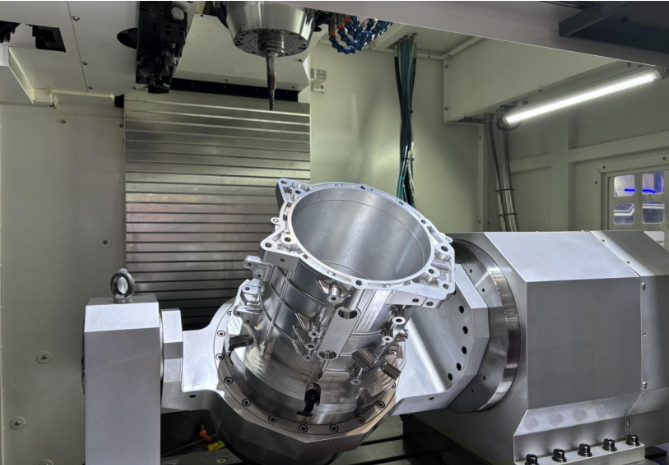
Figure 1: Multi-axis CNC machining enables simultaneous multi-angle operations, eliminating multiple setups and ensuring micron-level geometric accuracy for complex structural components.
Introduction
There is a paradigm shift going on within the industrial world today. Volatility in the economy, the emergence of new geopolitical corridors, and the erratic nature of consumer demands have revealed many gaps within traditional, volume-based industrialization processes. OEMs and product designers have for decades depended on mass production and offshore centers as a way of reducing unit cost. However, times have changed and today agility, resilience, and speed of delivery are what define competitiveness in the industrial world.
Custom component manufacturing is at the heart of the paradigm shift going on. The integration of precision engineering with digital fulfillment has enabled progressive companies to revolutionize their hardware delivery process.
From Prototyping to Full-Scale Production: Bridging the Valley of Death
Bringing any new hardware product to the market tends to face the dreaded “valley of death” – the hazardous period between design verification and volume production.
Historically, the fragmented nature of contract manufacturing splits the process among several companies:
l Supplier Sprawl: Prototyping (3D printing/metal sheeting) from Supplier A, Tooling & Injection Molding from Supplier B, Assembly from Supplier C.
l Cumulative Disputes: Duplicate quality controls, possibility of IP disclosure, massive delays at transition points.
l Engineering Incompatibilities: A simple modification to a tool can wreck any compatibility with machined housing, requiring costly redesigns for months.
The Turnkey Solution: A Unified Engineering Ecosystem
This is achieved through combining all the functions under one roof. Contemporary suppliers such as LS Manufacturing integrate state-of-the-art 5 axis CNC machining, mold tooling, plastic injection molding and vacuum casting into one single process.
Working with this type of ecosystem allows engineers to move seamlessly from rapid prototypes to pilot runs and full production without compromising on the accuracy of the process.
The Versatility Advantage: Mastering Diverse Fabrication Disciplines
Today’s modern equipment, auto sub-assemblies, medical devices, and consumer products are not composed of just one material or one method. A cutting-edge robotic joint, for instance, requires robust aluminum structures, high-wear-resistant metal gears, custom injection-molded elastomers, and stamped housings.
Supply-chain executives today are no longer looking for standalone machine shops; they want manufacturing partners who have capabilities in more than one discipline:
Precision Machining Services
Multi-axis CNC milling, turning, and 5-axis machining achieve micron-level tolerances for aerospace- and medical-grade alloys, allowing complex geometries to be machined directly from CAD models.
Advanced Tooling & Molding
Optimized tooling, insert molding, and overmolding allow for the utilization of high-quality engineering resins at significantly reduced per-unit costs.
Casting & Sheet Metal Forming
Die Casting, investment casting, vacuum casting, and sheet metal forming offer complete structural flexibility. By using laser cutting, CNC bending, and stamping, tough enclosures can be created with guaranteed time frames.
Turnkey Value-Added Solutions
The incorporation of secondary processes, including surface finishing, anodizing, powder coating, and electromechanical assembly, ensures that all components arrive ready for line installation.
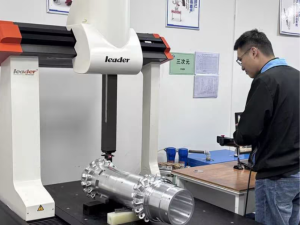
Figure 2: Caption: In-process CMM metrology inspection verifies critical dimensions, concentricity, and profile tolerances on high-precision custom parts.
Risk Mitigation in an Era of Geopolitical Recalibration
Component manufacturing in demand is extremely important as a way of hedging against global disruptions. As BizzBuzz Industry Trends states, global companies reduce risks by creating flexible networks which do not require retooling during multiple quarters. Digitalization helps do so with the use of automated inspection, CAM programming, and monitoring:
- Modular Flexibility: Automated setups and cell configurations enable changeover of production batches with little downtime, enabling OEMs to test the demand in small quantities at first.
- Inventory Management: Flexible capacity management enables manufacturers to make components only upon demand, thus avoiding the burden of over-stocking the warehouses.
- Quality Control: Coordinate measuring machines (CMM) and 3D Optical Scanning ensure traceable quality assurance and meeting requirements for ISO 9001 and IATF 16949 standards.
Conclusion
In the coming ten years, manufacturing will be in the hands of companies that foster agile, extremely transparent partnerships. With the advancement of industries such as robotics, electric mobility, and medical technology, making the machinery more complex, the constraint on hardware innovation will not be about feasibility anymore but rather about the ability to manufacture the product.
By aligning precision machining, flexible tooling, and added-value assembly within one process quality flow, on-demand manufacturing platforms are not only maintaining the global supply chain but creating the future of industry resilience.
FAQs
Q1: How does on-demand custom manufacturing help OEM’s reduce the cost of holding inventory?
A1: Customized manufacturing enables companies to produce component parts in small batches according to real demand rather than predictions. That way, it helps eliminate costly warehousing of surplus inventory, unlocks working capital, and reduces risks of obsolescence due to engineering changes in product designs.
Q2: What quality standards should procurement managers verify for turnkey partners?
A2: Procurement managers need to make sure that selected turnkey manufacturers have ISO 9001:2015 quality management systems certified, First Article Inspection (FAI) completed, material testing certificates provided, and in-house metrology, such as CMM probe inspections, for close tolerances of all manufactured lots.
Q3: How can one-source manufacturer reduce cross-process tolerance stacking?
A3: If several vendors manufacture mating components (for instance, CNC housing and injection-molded gasket), then even small tolerance inconsistencies tend to accumulate, causing assembly problems. In the case of one-source manufacturer, DFM and tooling are calibrated together in order to achieve seamless assembly process.
Q4: Can on-demand facilities handle low-volume runs without high tooling costs?
A4: Yes. Contemporary providers use rapid tooling, aluminum tools, and direct CNC machining to ensure that functional designs work within a small batch size ranging from tens to thousands.
Author Bio
LS Manufacturing provides custom component manufacturing through CNC machining, rapid tooling, plastic injection molding, sheet metal working and surface finishing. With its proven ISO quality standards, the company’s engineers assist global OEMs, robotics companies and hardware manufacturers to smoothly switch from rapid prototyping to volume manufacturing. Visit lsrpf.com for more information.