
Quick Answer
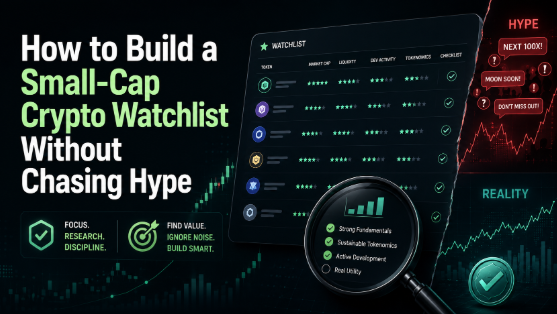
Build a small-cap crypto watchlist by defining objective filters first, eliminating assets with poor liquidity or unclear supply data, ranking survivors by fundamentals and verifiable catalysts, and reviewing the list on a fixed schedule, not in reaction to price spikes. Treat the watchlist as a research queue, not a buy list.
Key Takeaways
- No industry-standard cutoff exists for “small-cap crypto“, set your own bands instead of treating every sub-$1B token the same.
- Liquidity, not market cap, determines whether you can actually exit a position without heavy slippage.
- Score tokenomics and fundamentals separately; a good product with bad supply dynamics is still risky.
- Real catalysts are verifiable (a shipped product, a confirmed integration); hype is not (follower counts, “trending” status, vague labels like “AI” or “RWA”).
- Rank tokens by evidence, not price movement, a 50% pump isn’t new information.
Small-cap investing offers asymmetric upside, but thinner liquidity, weaker disclosure, and fast-moving narratives raise the downside. This guide covers five parts: scope, hard filters, liquidity, project quality, and catalysts.
What Counts as a Small-Cap Cryptocurrency?
There’s no universal cutoff. Data providers set their own thresholds, and these shift as the market grows or shrinks. CoinGecko, for example, currently groups tokens under $1 billion in market cap as small-cap, while noting they generally carry lower liquidity and higher risk than larger assets.
For a working watchlist, define narrower internal bands, say $10M–$100M versus $100M–$1B, rather than treating every sub-$1B token identically. A $50M token and a $900M token have very different liquidity and volatility profiles despite both being “small-cap.”
Track three numbers together: circulating market cap (value of tokens in circulation now), FDV (implied value if the entire supply were circulating), and the market cap/FDV gap, a quick read on dilution risk. A low token price doesn’t make a coin cheap, and a low market cap doesn’t automatically mean it’s undervalued, it may just have most of its supply still locked up.
How to Screen Small-Cap Coins Before Adding Them
This stage is hard filtering, not deep analysis. Before researching further, confirm a verified contract address, reliable supply figures, a meaningful trading history (not a freshly launched chart), identifiable trading venues, accessible documentation explaining the token’s purpose, and public allocation/unlock information.
| Check | Pass | Investigate | Reject / Avoid |
| Supply data | Clear, verifiable | Conflicting sources | Unavailable |
| Liquidity | Several usable markets | Highly concentrated | Practically untradeable |
| Token utility | Specific role | Unproven value capture | Purely vague claims |
| Documentation | Detailed, current | Incomplete | Missing |
| Ownership | Reasonably distributed | High concentration | Unexplained concentration |
Missing information should lower confidence, not get filled in with assumptions.
How to Check Liquidity and Whether You Can Actually Exit
Market cap tells you how a token is valued; liquidity tells you whether that valuation can actually be traded. Evaluate 24-hour spot volume rather than headline price moves, bid-ask spreads and order-book depth on centralized exchanges, DEX pool liquidity and expected slippage, how dependent volume is on one venue, and whether prices stay consistent across markets.
CoinMarketCap introduced an on-chain liquidity-to-market-cap metric in 2026 specifically because market cap alone doesn’t show how much a trade might move the price. Higher liquidity relative to market cap generally means better execution, though thin on-chain liquidity can also just reflect activity sitting on centralized exchanges rather than DEXs, so treat it as a prompt to dig deeper, not an automatic red flag.
As a data-checking example, not a recommendation: a researcher looking at a token like HANDL coin could use its listing on an exchange such as MEXC to check live price, volume, FDV, and trading pairs before deciding whether it merits deeper research. MEXC’s HANDL page currently shows roughly $2.79M FDV and $524.8K in 24-hour volume, while leaving circulating market cap unlisted, a gap that should trigger verification, not assumption. No single exchange page is the full market picture; cross-check aggregators and on-chain data too.
How to Score Fundamentals and Dilution Risk
Run this only after a token clears the screen and liquidity check. Score project quality on a 0–2 scale for each factor: product (live and usable?), adoption (measurable users, TVL, fees, integrations?), token necessity (does the product need the token?), development (visibly progressing?), and transparency (verifiable claims?). Don’t reward a large community or roadmap on their own.
Score supply risk separately: circulating versus total supply, insider and investor allocations, upcoming unlocks, the emission schedule, treasury holdings, wallet concentration, and whether staking yields come from real activity or inflation. Early-stage projects can carry more upside precisely because adoption is immature, but that also means forecasts rest on more assumptions.
How to Separate Real Catalysts From Hype
Ask one question of every piece of news: what new information changes the project’s probability of success? If the honest answer is “more people are talking about it,” that’s attention, not a catalyst.
Stronger signals
A verifiable product release, a mainnet or protocol upgrade, a confirmed integration evidenced by both parties, a measurable change in adoption or revenue, a tokenomics change with published terms, a dated regulatory milestone.
Weaker signals
Influencer enthusiasm, “trending” status, follower growth, unverified partnership claims, listing rumors, price pumps ahead of announcements, fashionable labels (“AI,” “RWA,” “DePIN”) without measurable relevance.
Social media is a reasonable place to discover candidates; it’s a poor place to approve them.
Explore: Trading Crypto on Your Nokia Mobile: A Comprehensive Guide
Decision Framework: Building and Maintaining the Watchlist
Turn the research into a system with explicit fields, not a running list of coins you liked. Track: project, sector, market cap, FDV, 24h volume, main liquidity venues, next unlock, fundamental thesis, next verifiable catalyst, main risk, invalidation condition, and a research score.
Rank tokens by status, not price target:
- Research — insufficient information, needs verification.
- Watch — passes core filters but needs a catalyst, better valuation, or stronger liquidity.
- Remove — thesis invalidated, liquidity deteriorates, or tokenomics worsen.
Review on a fixed schedule and after major project events, not intraday price swings. A 50% move in a day shouldn’t automatically climb a token up your list, only new evidence should.
Conclusion: A Watchlist Is a Research Queue, Not a Buy List
Small-cap selection works best when it starts with exclusion. Market cap tells you size; liquidity, tokenomics, fundamentals, and catalysts tell you whether an asset deserves attention at all. Use social activity to find candidates, never to validate them, and keep explicit rules for adding and removing tokens.
As of August 11, 2026, total crypto market cap sits near $2.27 trillion with Bitcoin dominance around 56.6%, following a Q2 in which market cap fell 12.6% and top-10 exchange spot volume dropped 27.9%. That backdrop is a reminder that liquidity and execution discipline matter more for small caps than assuming every low-cap token benefits equally from a recovery.
FAQ
What is considered a small-cap cryptocurrency?
No single standard exists. Some providers, including CoinGecko, currently classify tokens under $1 billion in market cap as small-cap, though the threshold shifts with the market.
How do I know if a small-cap coin has enough liquidity to trade safely?
Check 24-hour spot volume, bid-ask spreads, order-book depth, and DEX pool liquidity relative to your trade size. Volume concentrated on one exchange is riskier to exit than market cap alone suggests.
Is a low market cap the same as being undervalued?
No. A low circulating market cap can sit alongside a much higher FDV, meaning significant dilution as more tokens unlock.
How often should I review a crypto watchlist?
On a fixed schedule, weekly or monthly, and after major project events, not daily price swings.
Do exchange listing pages give a complete picture of a token?
No. They show venue-specific data but should be cross-checked against aggregators, on-chain data, and project documentation.