
Turn a patterned sweater inside out. If you see a floating web of colored yarns running behind the design, or a neat reverse of the pattern in swapped colors, you’re holding a jacquard knit. If the inside is plain and the pattern only exists on the outer surface, it’s been printed on. Same look from the front, completely different garment.
Most shoppers never flip the sweater over, and most product photos never show the inside. That matters because the two construction methods behave very differently over time, feel different on the body, and cost different amounts to make. Here’s what jacquard knit actually means, how it compares to printing, and how to tell which one you’re buying.
What is a jacquard knit?
Jacquard refers to a knitting technique where the pattern is created by the knitting itself. Multiple yarn colors are fed into the machine, and the machine selects which color appears at each stitch to form the design. The pattern isn’t applied to the fabric; the pattern is the fabric.
The name comes from Joseph Marie Jacquard, who developed a punch-card loom in the early 1800s that automated complex weaving patterns. Modern knitting machines use the same principle with electronics instead of punch cards. Any all-over patterned knit you’ve seen, from Fair Isle sweaters to those cardigans with cats or skeletons worked into them, is very likely jacquard or a close cousin.
How is a printed sweater made?
A printed sweater starts as a plain knit. The design is then applied to the surface with one of a few methods: screen printing, direct-to-garment inkjet printing, or heat-transfer sublimation. Sublimation actually excels on polyester rather than knit wool, which is why a nerdy mesh jersey can hold a crisp all-over print for years while the same method on a sweater’s surface is a compromise. The ink or dye sits on the outer layer of the knit.
This is faster and cheaper to produce, and it allows photographic detail that knitting can’t match. It also means the design has a different relationship with the fabric. When the knit stretches, the print stretches with it and can crack. When the fibers pill, the pilled surface takes the design with it.
Why does knit-in patterning last longer?
Three reasons.
First, there’s nothing to crack or peel. The color goes all the way through the yarn, so wear on the surface just reveals more of the same color.
Second, fading is minimal. Yarn is dyed before knitting, and dyed yarn holds color far better than surface ink.
Third, the pattern survives pilling. A pilled jacquard still shows its design clearly; a pilled print looks blurred and fuzzy because the pills lift the ink off the surface.
A patterned cardigan I’ve watched someone wear for four winters, a jacquard knit with a dense cryptid motif, looks essentially the same as it did new aside from slightly softer edges. A printed sweatshirt bought the same year has a design you can barely make out.
Are there downsides to jacquard?
A few honest ones.
Jacquard knits are heavier, because the floating yarns behind the pattern add material. In a chunky cardigan that’s a feature; in a summer knit it’s a drawback.
Detail is limited to the stitch resolution. Very fine gradients and photographic imagery aren’t possible. Bold, graphic designs with clear color boundaries suit the technique; a photo of a movie poster doesn’t.
Cost is higher. More yarn, slower production, more complex machine setup. The price gap has narrowed a lot as knitting machines have improved, but it’s still real.
How can you tell which one you’re looking at online?
- Look for the words. “Jacquard,” “knit-in,” “intarsia,” or “knitted pattern” all mean the design is in the fabric. “Printed,” “graphic,” or “all-over print” on a knit usually mean surface application.
- Check for close-ups. Jacquard product photos often zoom in to show individual stitches forming the design. Prints look smooth at close range.
- Look at the color boundaries. Jacquard edges follow the stitch grid and are very slightly stepped. Printed edges are perfectly smooth.
- Check the weight. A heavier gauge listed for a patterned piece often signals knit-in.
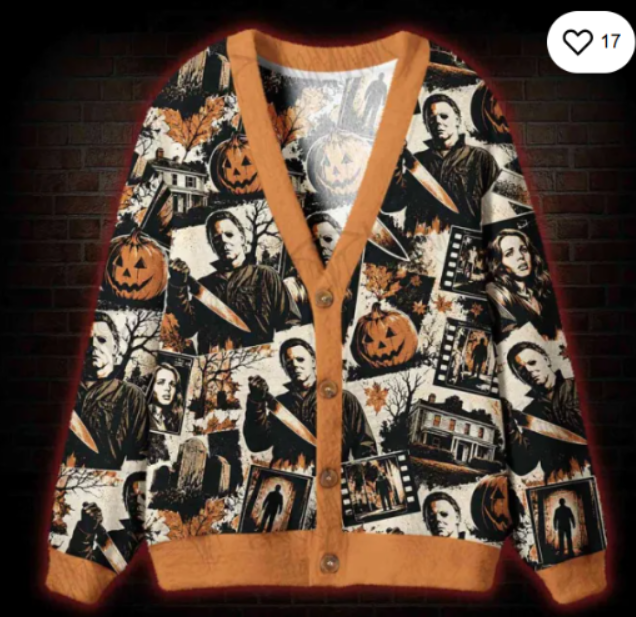
Brands that specialize in patterned knitwear tend to be explicit about it. The current generation of nerdy cardigan sweaters with horror, occult, and astrology motifs is a good example: the designs are bold, high-contrast, and clearly built for a knit-in approach, which is exactly the kind of imagery that outlasts a printed alternative by years.
What about intarsia?
You’ll see this word too. Intarsia is a related knit-in technique where each color area is knitted as a separate block with no floating yarns behind it. It produces a lighter fabric than jacquard and clean single-layer color blocks, but it’s harder to automate and usually reserved for larger, simpler motifs. For the purposes of buying a patterned cardigan, intarsia and jacquard behave similarly in wear and both beat printing on longevity.
Which should you actually buy?
If the design matters to you and you want it to look the same in three years, knit-in. If you want a photorealistic image or the lowest possible price for a single season, printed.
For all-over patterns specifically, the answer is nearly always jacquard. Printing an entire sweater’s surface is the worst-case scenario for cracking, because every square inch of ink is being stretched every time you move. Knitting the pattern in avoids the problem entirely.
The two-second check
Next time you’re in a store, flip the sweater. Floating yarns or a reversed pattern inside means it’ll last. A plain inside with a design only on the front means enjoy it while it’s new. Same rule applies when a product page includes an inside-out photo, which, if a brand is proud of its construction, it often will.